
Anuradha Mandal

Communication Coach and Author

judicial services exam

Judicial Services Exam : Simple and Easy Guidebook for 2022

Judicial Services Exam also called the PCS (J)- Provincial Civil Service Judicial Examination is the first level examination for the law graduate to be allotted the members in the subordinate judiciary.


The members are appointed under the supervision of the respective high court by the state government. This exam is conducted by a state judicial department for the recruitment of subordinate judicial services.


There are various lucrative features in this service apart from superb perks, allowances, etc. Some of the job roles an applicant can get after clearing the exam are mentioned below.


Job Roles: Judicial Services Exam

  • Magistrate
  • District and Session Judge
  • Sub-Magistrate
  • Public Prosecutor
  • Attorney General
  • Solicitors
  • Advocate General
  • Notary
  • Oath Commissioner


The members of the subordinate judiciary of the state are under the supervision of the High Court and its jurisdiction is also under the High Court.  Every year approximately 50,000 -60,000 students appear for this examination.


The Judicial services exam has 2 entry-level. They are given below :

  1. Lower Judiciary Services
  2. Higher Judiciary Services


Eligibility of Judicial Services Exam


Eligibility of Judicial Services Exam

Service

Nationality Age Qualification

Experience

Lower Judiciary Services


Should be a citizen of India 21-35 years Must have a degree in LL. B from a recognized University/Institution. Final year candidates can also apply No experience is required
CandidateS should have enrolled as an Advocate under the Advocate’s Act 1961
Higher Judiciary Services


Should be a citizen of India 21-35 years Must have a degree in LL. B from a recognized University/Institution. Minimum of 7 years of experience in litigating practice


Judicial Services Exam For Different States


Judicial services exams are held for a total of 24 States in India conducts this exam. Each state has its own set of vacancies, selection process, eligibility criteria, exam pattern, and pay scale. The states are named below:

  1. Arunachal Pradesh
  2. Assam
  3. Bihar
  4. Chhattisgarh
  5. Goa
  6. Delhi
  7. Himachal Pradesh
  8. Haryana
  9. Jammu & Kashmir
  10. Jharkhand
  11. Karnataka
  12. Kerala
  13. Madhya Pradesh
  14. Maharashtra
  15. Manipur
  16. Mizoram
  17. Nagaland
  18. Odisha
  19. Punjab
  20. Rajasthan
  21. Sikkim
  22. Uttarakhand
  23. Uttar Pradesh
  24. West Bengal


Judicial Services Exam Pattern:

This Judicial services exam is comprised of 3-stages:


Judicial Services Exam Pattern

Factors

Preliminary Exam Main Exam

Personal Interview

Exam type Objective and act as a screening test for the main exam Subjective with 3-4 papers Candidates are evaluated on general knowledge and aptitude. Minimum of 20 marks to be secured to get selected. This is the final stage of selection.
Qualifying Marks Minimum qualifying marks vary from State to state Minimum qualifying marks vary from State to state
Evaluation Criteria Marks not calculated Marks scored are counted for the final selection


Responsibility and Career of Judge

Judicial Services Exam


The Judicial System consists of Supreme Court, High Court, District Court, Magistrate Court, and Munsiff Court. Judges are assigned to the different levels of court as per their qualifications and experience required for a particular department.


The Responsibilities Of The Judges 

  • Implement rules of procedure and establish the law.
  • Take the charge over trials and hearings
  • Advise litigation or court concerning issues and conduct the proceeding of the case.
  • Settle disputes between defending attorneys
  • Evaluate and gauge the evidence to decide whether the accused is innocent or guilty in accordance with the law.
  • In the case of Civil trials, the judge decides whether the petition is legitimate and decides the damage, and orders compensation to the plaintiff unless a jury has been set to give the decision.
  • In case of criminal trials, the judge decides whether to hold the offender in prison pending trial or allow bail.
  • In case the accused is convicted, the judge declares the sentence. The judge imposes a  fine, sends the person to jail or both, depending on what the constitution ordered.

Note: The Munsiff /Sub-Judge deals with the civil cases while the Magistrate deals with the criminal cases.


The Constitution of India : 3 Tier Judicial System

The Constitution of India has a 3 tier Judicial System mentioned below:

Supreme Court (SC) 

The Supreme Court is the apex court and the ultimate court of appeal under the Constitution of India. The Supreme court consist of the Chief Justice of India and 30 Additional Judges.


The Chief Justice of India (CJI) is the highest-ranking Judge in the Supreme Court of India. The President appoints the Chief Justice of India and they can retain their position till the age of 65 years.


High Court (HC)

The High Court is the top judicial authority in the States controlled and managed by Chief Justice of States. The President appoints the High Court Judges by consulting with The Chief Justice of India and Governor of State, and they can retain their position till the age of 62 years.


District Court (DC)

Each state is divided into Judicial districts governed by a District Judge and Session Judge. The Civil case is looked at by District Judge and the criminal cases are looked at by the Session Judges.


The Judges of the district court are appointed by the Governor in consultation with the Chief Justice of the High Court of the concerned state.


Magistrate/Munsiff

The Magistrate or the Munsiff are elected by the Central or State Government in consultation with the Chief Justice of the High Court of the concerned state.


Judicial Hierarchy


Court Post

Cadre

Service

Chief Justice of India Justice Cadre Justice Grade
Justice of Supreme Court
Chief Justice of the High Court
Justice of the High Court
District & Session Judge District & Session Judge Cadre Superior/Higher Judicial Service
Additional District & Session Judge
Chief Judiciary Magistrate/Chief Metropolitan Magistrate Civil Judge (Senior Division) Lower Judicial Service
Judicial Magistrate 1st Class/ Metropolitan Magistrate Civil Judge (Senior Division)
Judicial Magistrate 2nd Class Civil Judge (Entry/Probationary /Training)


To secure a good rank and seat in the Judicial services exam, need lots of planning, research, and a proper road map.


Career Planning plays an important role in shaping your career, so is the planning to choose the best suitable B-School for yourself. You need to focus on various aspects before jumping into a final decision.


Career path analysis helps you in getting the best road map. Get your career assessment test by appearing for the free student profiling process. https://eduxact.edumilestones.com/

 

Study_Abroad
Study_Abroad


Click the link below and get an exhaustive career report and book for a free counseling session.  For Studying abroad in 15000+ across 20+ Countries visit the mentioned link.


Click: Start Study Abroad Profiling to get access to 15000+ Universities across 20+ Countries


Please share your valuable inputs regarding the article. Also, help me develop other information guides by giving your suggestions.


You can comment in the section below for sharing your thoughts.

 

Career Counselling
Career Counselling


Judicial Services Exam : Simple and Easy Guidebook for 2022 Read More »
SNAP EXAM

SNAP EXAM : Simple And Essential Information

SNAP Exam is a national-level management aptitude test conducted by Symbiosis (Deemed) University (SIU), Pune for admission to the MBA/PGDM program.


Symbiosis National Aptitude Test is popularly known as SNAP is the MBA Entrance exam for admission to 16 Symbiosis Institute in India.


Students across all parts of India take this exam from different disciplines like Engineering, Commerce, Humanities, and Law.


SNAP Exam: List of Constituent Institute


SNAP encompasses a list of 16 constituent Institute are given below:

S.No

Name of the Institute Courses

No of Seats

1 Symbiosis Institute of Business Management (SIBM, Pune) MBA (Innovation and Entrepreneurship) 220
2 Symbiosis Institute of Computer Studies & Research (SICSR, Pune) MBA (Information Technology) 90
M.Sc (Computer Applications) 30
M.Sc (System Security) 30
3 Symbiosis Centre for Management and Human Resource Development (SCMHRD, Pune) MBA (Infrastructure Development and Management) 250
MBA (Business Analytics) 120
4 Symbiosis Institute of International Business (SIIB ,Pune) MBA (International Business)
MBA (Agri-Business) 30
MBA (Energy & Environment) 60
5 Symbiosis Institute of Telecom Management (SITM ,Pune) MBA (Telecom Management) 150
6 Symbiosis Institute of Management Studies (SIMS ,Pune) MBA 120
7 Symbiosis Institute of Media & Communication (SIMC ,Pune) MBA (Communication Management) 120
8 Symbiosis Institute of Operations Management (SIOM, Nashik) MBA (Operation Management) 150
9 Symbiosis Centre for Information Technology (SCIT ,Pune) MBA (Information Technology Business Management) 210
MBA (Data Sciences and Data Analytics) NA
10 Symbiosis Institute of Health Sciences (SIHS ,Pune) MBA (Hospital & Healthcare Management) 90
11 Symbiosis Institute of Business Management (SIBM ,Bengaluru) MBA 150
12 Symbiosis School of Media & Communication (SSMC ,Bengaluru) MBA (Communication Management) 80
13 Symbiosis School of Banking and Finance (SSBF, Pune) MBA (Banking & Finance) 50
14 Symbiosis Institute of Business Management (SIBM, Hyderabad) MBA 150
15 Symbiosis School of Sports Sciences (SSSS, Pune) MBA (Sports Science)
16 Symbiosis Institute of Business Management (SIBM, Nagpur) MBA


Highlights of SNAP Exam


Features

Details

Exam Name Symbiosis National Aptitude Test (SNAP)
Conducting Body Symbiosis International (Deemed) University (SIU)
Exam Level
Exam Frequency Once a year
Exam Section 3
Exam Format MCQs & Non-MCQs Format
Exam Duration 2 hours
Exam Mode Online
Exam Language English
Exam Fees Rs. 1750
Courses Offered MBA/PGDM
Number of Question 110
Number of colleges accepting SNAP score SIU Colleges + 20 other institute
Official Website https://www.snaptest.org/


SNAP Exam-Proposed Month

Exam

Tentative Registration Month

SNAP Notification August
SNAP Admit Card December
SNAP Exam December
SNAP Result January


snap eligibility

Eligibility Criteria

Nationality

The following citizen can apply for SNAP Exam

  • Indian citizen as well as NRI
  • Person of Indian Origin (PIO)
  • Overseas Citizen of India (OCI)
  • Foreign Nationals

Age Limit

  • There is no age limit to take SNAP Exam.

Educational Qualification

  • The candidate must have a bachelor’s degree or its equivalent with a minimum of 50% (45% for SC/ST/PWD) marks in aggregate from a recognized University or equivalent to appear for SNAP Exam.
  • Appearing and result awaited candidates are also eligible to appear for the exam.
  • International students or candidates who have graduated from International University, have to obtain a certificate of equivalence from the Association of Indian University (AIU)

Number Of Attempts

  • There is no limit on the number of attempts to take the exam.


SNAP Exam Pattern 

Feature

Details

Exam Mode Computer Based Test (CBT)
Name of sections General English, Analytical & Logical Reasoning and Quantitative Data Interpretation and Data Sufficiency
Number of Questions 110
Exam Duration 2 hours
Medium of Exam English
Negative Marking 25% of the marks allotted to the question


SNAP Exam: Section-Wise 

Sections

Normal questions Special Question Total Question

Total Marks

General English: Reading Comprehension, Verbal Reasoning, Verbal Ability 34 0 34 51
Analytical & Logical Reasoning 36 0 36 54
and Quantitative Data Interpretation and Data Sufficiency 35 5 40 45
Total 105 5 110 150


Getting into a good college is a dream, you need lots of planning and research before drawing a conclusion.


Career Planning plays an important role in shaping your career, so is the planning to choose the best suitable option for yourself. You need to focus on various aspects before jumping into a final decision.


Career path analysis helps you in getting the best road map. Get your career assessment test by appearing for the free student profiling process. https://eduxact.edumilestones.com/


Study_Abroad
Study_Abroad


Click the link below and get an exhaustive career report and book for a free counseling session.  For Studying abroad in 15000+ across 20+ Countries visit the mentioned link.


Click: Start Study Abroad Profiling to get access to 15000+ Universities across 20+ Countries


Please share your valuable inputs regarding the article. Also, help me develop other information guides by giving your suggestions.


You can comment in the section below for sharing your thoughts.


Career Counselling
Career Counselling


SNAP EXAM : Simple And Essential Information Read More »

NID DAT EXAM

NID DAT Exam : A Detailed Free Guide

NID DAT Exam is a national-level exam. NID Design Aptitude Test is an entrance examination for shortlisting the candidate willing to take admission in UG and PG design courses offered at National Institute Design (NID) campus. The National Institute of Design (NID) is a design school located in Ahmedabad with several other campuses across India.


This is an autonomous body under the Department for Promotion of Industry and Internal Trade (DPIT), Ministry of Commerce and Industry, Government of India. The Department of Scientific and Industrial Research under the Ministry of Science and Technology, Government of India, as a scientific and industrial design research organization recognizes NID.


NID is granted as “Institute of National Importance” by the Act of Parliament, under the National Institute of Design Act,2014.


NID DAT Campus


S.No

Name of the Institute Established Year

State

1 National Institute of Design, Ahmedabad (Heritage Campus) 1961 Gujarat
2 National Institute of Design, Gandhinagar (Post Graduate Campus) 2004 Gujarat
3 National Institute of Design, Bangalore (R&D Campus) 2006 Karnataka
4 National Institute of Design, Vijayawada 2015 Andhra Pradesh
5 National Institute of Design, Jorhat 2019 Assam
6 National Institute of Design, Kurukshetra 2016 Haryana
7 National Institute of Design, Bhopal 2018 Madhya Pradesh


  NIT DAT Exam Highlights


Highlights

Details

Exam Name NID Design Aptitude Test
Exam conducting body National Institute of  Design (NID)
Exam Level National
Exam Frequency Once a year
Exam Mode Offline
Exam Paper Preliminary  & Mains
Exam Duration B.Des/GDPD -3 hours
M.Des -2 hours 30 minutes
Exam Medium English
Exam Purpose Admission to 7 NIDs
Number of College accepting NIFT score 7
Official Website http://www.nid.edu/


NID offers different Diplomas, Undergraduate, Postgraduate, PhD in Design, and other Foundation courses in design like Bachelor of Design, Graduate Diploma Program in Design, and Master of Design.


B.Des Course

GDPD Course

M.Des Course

Ceramic & Glass Design Industrial Design Animation & Film Design
Furniture & Interior Design Communication Design Ceramic & Glass Design
Product Design Textile & Apparel Design Furniture & Interior Design
Exhibition Design Film & Video Communication
Graphic Design Graphic Design
Animation & Film Design Product Design
Film & Video Communication Textile Design
Textile Design Apparel Design
Lifestyle Accessory Design
Strategic Design Management
New Media Design
Photography Design
Toy & Game Design
Transportation & Automobile Design
Design for Retail Experience
Digital Game Design
Information Design
Interaction Design
Universal Design


NID DAT Exam: Proposed Month


Events

Tentative Month

NID Notifiacation October
NID Prelim Admit Card December
NID Prelim Exam December
NID Prelim Result (M.Des) February
NID Prelim Result (B.Des) May
NID Mains Admit Card (B.Des) June
NID Mains Admit Card (M.Des) June
NID Mains Exam (B.Des) June
NID Mains Exam (M.Des) July
NID Result July
NID Counselling July


NID DAT ELIGIBILITY


Eligibility Criteria


Nationality

  • Indian Citizen
  • Person of Indian Origin (PIO)
  • Overseas Citizen of India (OCI)
  • Non-Residents of India (NRI) and
  • Foreign Nationals are eligible to apply


Course

Educational Qualification

Age Limit

Bachelor of Design- B.Des)/GDPD Candidates who have passed/appeared in Class 12th or equivalent from any of the recognized boards or its equivalent and have to produce the certificate at the in-person counselling. Not more than 20 years for General Candidate (SC, ST, NCL – up to 3 & PWD -5 years of relaxation.)
Candidates who have passed class 12th or equivalent conducted by National open School with a minimum of 5 subjects
Candidates who have passed 3 or 4 years of Diploma recognized by AICTE or State Board of Technical Education
Candidates who have taken the General Certificate Education Examination in London/Sri Lanka at an Advanced (A) Level/International Baccalaureate (IB)
Candidate who have taken the exam in Foreign countries and should be recognized by the Association of Indian Universities as equivalent to the 10+2 system
Master of Design (M.Des) Candidates who have passed/appearing graduation from a recognized university or equivalent Not more than 30 years for General Candidate (SC, ST, NCL – up to 3 & PWD -5 years of relaxation.)
Candidates who have passed/appearing a full-time 4 years Diploma in Design/ Arts/ Fine Arts/Applied Arts/Architecture after Class 12 from a recognized university or its equivalent.


Overseas Category:


  • The Foreign Nationals candidate can apply for the NID exam only under the overseas Supernumerary category provided they fulfill all the eligibility criteria mentioned in the notification.
  • The Supernumerary seat for an overseas candidate is not applicable for the GDPD program in NID Andhra Pradesh, NID Haryana, NID Madhya Pradesh & NID Assam.
  • Candidates holding OCI and PIO cards will have to apply only under the Overseas supernumerary category.
  • NRIs are not eligible to apply under the Overseas supernumerary category. They must apply as Indian Nationals.
  • Overseas candidates must sit for both the exams like the NID Prelim and the NID Mains.
  • Candidates holding a degree/certificate from a university /institute of any other country other than India, will have to produce an equivalence certificate from the Association of Indian University (AIU), New Delhi.


Program

Number of Seat

Bachelor of Design -B.Des NID Ahmedabad 19
Master of Design (having 19 seats) 3
Master of Design (having 12 seats) 2


NID DAT Exam Pattern for B.Des & GDPD.


NID DAT consists of two stages:

  1. NID DAT (Prelims)
  2. NID DAT (Mains) consists of Studio Test and Personal Interview


NID DAT Prelims Exam Pattern for B.Des & GDPD


Exam Pattern

B.Des & GDPD

M.Des

Exam Mode Paper & Pen based- Offline Paper & Pen based- Offline
Number of Sections Section A & Section B Section A & Section B
Number of Questions Section A- 64 MCQs Section A- 59 MCQs
Section B -3 Subjective Section B -3 Subjective
Total Marks 100 100
Exam Duration 3 hours 2 hours 30 minutes
Negative Marking No No


NID DAT (Mains) consists of Studio Test and Personal Interview for B.Des & GDPD


Candidates who qualify for the DAT Preliminary exam are called for DAT Mains exam which include a Studio Test of 100 marks. Studio Test assess the candidate’s ability in sketching/drawing, handicraft modelling and group discussion.


NID DAT Exam Pattern for M.Des


  • The Master of Design DAT Prelim consist of a Common Design Aptitude Test (CDAT) and a faculty-specific Domain Test which evaluates the visualization, creativity, analysis, knowledge, and comprehension of the candidate.
  • There are 2 sections in the exam having objective and subjective questions.
  • The paper is in English language having no negative marks


NID DAT (Prelims) for M.Des


M.Des with One Discipline

M.Des with Two Discipline

Candidate must write NID Prelim which includes CDAT and a Faculty-specific domain test Candidate must write NID Prelim which includes CDAT and one Faculty-specific domain test if both the subjects fall under the same Faculty OR
Candidate must write NID Prelim which includes CDAT and two Faculty-specific domain test if both the subjects fall under  two different Faculty
Duration of the exam is 150 minutes Duration of the exam is 150 minutes


NID DAT (Mains) consists of Studio Test and Personal Interview for M.Des


This is the second stage of the selection process. The candidates who qualify in the first stage of the selection process are eligible to appear for the DAT Mains exam.


Studio Test:


  • It comprises of different sections assessing on various parameters such as hands-on drawing/sketching, hands-on model making, group discussion.


  • The duration of the exam is 3 hours.


Interviews: 

This is conducted separately for each discipline after the Studio test.


Getting into a good college is a dream, you need to plan and research a lot before drawing any conclusion.


Career Planning plays an important role in shaping your career, so is the planning to choose the best suitable B-School for yourself. You need to focus on various aspects before jumping into a final decision.


Career path analysis helps you in getting the best road map. Get your career assessment test by appearing for the free student profiling process. https://eduxact.edumilestones.com/


Study_Abroad
Study_Abroad


Click the link below and get an exhaustive career report and book for a free counseling session.  For Studying abroad in 15000+ across 20+ Countries visit the mentioned link.


Click: Start Study Abroad Profiling to get access to 15000+ Universities across 20+ Countries


Please share your valuable inputs regarding the article. Also, help me develop other information guides by giving your suggestions.


You can comment in the section below for sharing your thoughts.


Career Counselling
Career Counselling


NID DAT Exam : A Detailed Free Guide Read More »

TOEFL EXAM

TOEFL : Popular English Breakthrough Exam for 2022

TOEFL stands for Test of English as a Foreign Language is a standardized English language competency test designed for people who want to study or work abroad where the language of communication is English. This test is accepted by many English-speaking academic and professional universities.


It was started in 1964 and is the most popular English language certificate in the world. The Educational Testing Services (ETS) is the conducting body of the Test of English as a Foreign Language.


ETS is responsible for setting the question paper, conducting the tests, and also sending the scorecard to each and individual examinee. TOEFL iBT test is an internet-based test scored on a scale of 0 to 120 points.


There are around 4500 tests centers in more than 165 countries carrying almost 2.3 million tests every year. More than 10,000 colleges, organizations, institutions, and agencies across the globe accept this certificate as proof of proficiency in the English Language.


The exam mainly checks the capability of the test takers’ communication in the four basic English language skills, like listening, reading, speaking & writing.


Mostly the Canadian and American Universities along with other institution accepts the score for admission.


TOEFL Exam: Need and Advantages 

The TOEFL Exam is undertaken by the candidates who are planning to study and take admission in foreign universities and colleges. This exam is important as the foreign universities and visa granting authorities want to get sure that one does not face communication problems while staying in the country.

The exam is not mandatory as many universities might not even accept the TOEFL score for admission. But your chance of getting a student visa may decrease as the visa officer may not be convinced about your English proficiency without the TOEFL score.

Therefore, it is always advisable to take the TOEFL exam which makes the students eligible for scholarships and also help the candidates for the job along with their visa application process.

TOEFL is mostly accepted by Canadian and American Universities compared to other countries. It is conducted by the ETS which guarantees the students a fair and unbiased process of score reporting.


Types of TOEFL Exam 

The  Test of English as a Foreign Language test is conducted in two formats namely  IBT (Internet Based Test ) and PBT (Paper Based Test ).

  1. TOEFL IBT: Internet-based test is an online test and this is a more preferred test compared to the offline test.
  2. TOEFL PBT: Paper-based test is an offline test where paper and pen are used extensively for the exam. This is not preferred by the candidates. Also, this format of the test does not conduct the speaking test due to the availability of limited resources.


Highlights of the TOEFL Exam 

Exam Name

TOEFL

Full-Form Test of English as a Foreign Language
Conducting Body Educating Testing Services (ETS)
Accepted by Most popularly by Canada and America, also accepted by UK, Australia and New Zealand
Mode of Exam Internet-based and Paper based
Score Band Score  0-120 points
Exam Fees Registration fees for India is approx.  Rs. 13,605 (180$)
Official Website https://www.ets.org/toefl


Eligibility of Exam

Anyone can appear for this exam irrespective of age, race, gender, nationality, and religion.

Age

Educational Qualification

Attempts

There is no specified age required to appear for the exam. There is no minimum educational qualification needed, anyone who has passed high school or equivalent can write the exam There is no set limit for the number of attempts. But one cannot take the exam within 12 days of the previous exam. Only 5 attempts in a year are allowed.


Registration of TOEFL Exam

TOEFL test is conducted as many as 50 times a year by the conducting authorized center. There is no set limit for the number of attempts.  But one cannot take the exam within 12 days of the previous exam. Only 5 attempts in a year are allowed.


The Registration fee for the exam in India is approximately Rs. 13605 (180$), every time you appear for the exam you need to register with this amount of money.  Registration can be done in both the mode, is online and offline ( In-person).


Online TOEFL Registration 

Steps to Register for the Exam :

  • Step 1: Visit the official website of TOEFL. Create a new account or login into the already existing account.
  • Step 2: Go to the button ‘Register for Test ‘ option.
  • Step 3: Fill in personal details.
  • Step 4: Select preferred available Test Date
  • Step 5: Select the preferred available Test center.
  • Step 6: Pay the registration fees.
  • Step 7: Take the print of the acknowledgment receipt

Offline (In-Person) TOEFL Registration 

You can register for the exam in person also by visiting the TOEFL India Office.

Office Information

Prometric

2nd Floor, DLF Infinity Tower -A

Sector – 25, Phase -II, DLF City

Gurugram, Haryana-122002


TOEFL EXAM

TOEFL Exam Pattern 

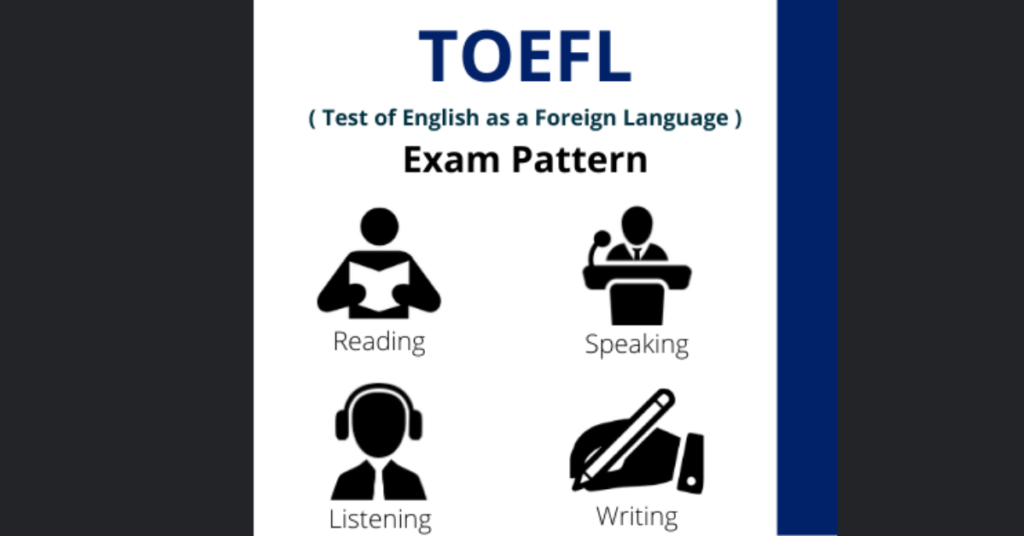
The test pattern comprises four sections-Listening, Reading, Writing, and Speaking. You get individual scores for all four sections as well as the total scores.

Internet-Based Test Pattern 

Internet-Based Exam Pattern

Component Description

Duration

Reading 3-4 Passages each having 10 questions 54-72 minutes
Listening 5-7 Passages each having 5-6  questions 41-57  minutes
Mandatory break
Speaking 4 tasks 17 minutes
Writing 2 tasks 50 minutes


TOEFL Paper Based Exam Pattern

Paper-Based Exam Pattern

Component Description

Duration

Listening There are 3 parts :

Part 1: 30 question about a short conversation

Part 2: 8 questions about a long  conversation

Part 3: 12 questions about talks & lectures.

30-40 minutes
Structure and Written Expression 15 exercises for completing sentences

24 exercise for identifying errors

25 minutes
Reading Comprehension 50 questions about reading passages 55 minutes
Writing Test of Written English (TWE). One essay with 250-300 words 30 minutes

Description of the TOEFL Internet Based Exam Score: The four-section scores of the exam are divided as follows :

Component

Score Range

Mean Score

Reading

0-30

20

Listening

0-30

19

Speaking

0-30

19

Writing

0-30

20

Total Score

0-120

80

Description of the TOEFL Paper Based Exam Score:  The four-section scores of the exam are divided as follows :

The final PBT score ranges between 310-677 based on the below subscores

Component

Scores

Listening

31-68

Structure and Written Expression

31-68

Reading Comprehension

31-67

Writing This is not a part of the final score. It is marked on a scale of 0-6

TOEFL: Exam Result 

  • Online Mode: Intimation will be received through the mail by ETS after 10 days of giving the exam. The result can be printed after 13 days of the exam.
  • Offline Mode: For the offline or paper-based test, the result will be declared 5 weeks after the test date.


TOEFL Validity Period

The validity of the TOEFL score is for 2 years.


Getting into a good college is a dream, you need lots of planning and research before drawing a conclusion.


Career Planning plays an important role in shaping your career, so is the planning to choose the best suitable option for yourself. You need to focus on various aspects before jumping into a final decision.


Career path analysis helps you in getting the best road map. Get your career assessment test by appearing for the free student profiling process. https://eduxact.edumilestones.com/


Study_Abroad
Study_Abroad


Click the link below and get an exhaustive career report and book for a free counseling session.  For Studying abroad in 15000+ across 20+ Countries visit the mentioned link.


Click: Start Study Abroad Profiling to get access to 15000+ Universities across 20+ Countries


Please share your valuable inputs regarding the article. Also, help me develop other information guides by giving your suggestions.


You can comment in the section below for sharing your thoughts.


Career Counselling
Career Counselling


TOEFL : Popular English Breakthrough Exam for 2022 Read More »

NIFT

NIFT : Everything You Need For This Amazing Career

NIFT is commonly known as the National Institute of Fashion Technology. It was established in 1986 under the Ministry of Textiles, Government of India is an autonomous fashion design and technology institute. NIFT was declared a statutory institute in 2006 and empowered the authority to grant degrees by the Act of the Indian Parliament.


NIFT entrance exam is conducted by the National Institute of Fashion Technology (NIFT), to shortlist aspirants for taking admission in the design program NIFT’s headquarter is in New Delhi and there are 17 NIFT campuses spread across India, namely:

NIFT Campus 


S.No Campus Seat
1 NIFT Delhi 413
2 NIFT Chennai 371
3 NIFT Kolkata 336
4 NIFT Gandhinagar 287
5 NIFT Hyderabad 294
6 NIFT Mumbai 334
7 NIFT Bangalore 371
8 NIFT Bhopal 133
9 NIFT Bhubaneswar 266
10 NIFT Jodhpur 266
11 NIFT Kangra 221
12 NIFT Kannur 311
13 NIFT Patna 265
14 NIFT Raebareli 210
15 NIFT Shillong 133
16 NIFT Srinagar 84
17 NIFT Panchkula
Total 4297


Exam Highlights


Highlights Details
Exam Name National Institute of Fashion Technology Entrance Exam
Exam conducting body National Institute of Fashion Technology (NIFT)
Exam Level National
Exam Frequency Once a year
Exam Mode Offline
Exam Duration Creative Aptitude Test (CAT) for BDes: 3 hours
General Aptitude Test (GAT) for BDes & MDes  : 2 hours
General Aptitude Test (GAT) for BFTech, MFM, MFTech : 3 hours
Exam Medium English
Exam Purpose Admission to 17 NIFTs
Number of College accepting NIFT score 17
Courses Offered BDes, BFTech, MDes, MFTech, MFM
Official Website https://www.nift.ac.in/


NIFT Course


It offers different courses for an undergraduate, postgraduate, and doctoral programme in design, management, and technology.

Undergraduate courses Postgraduate Courses
Bachelor of Design in Fashion Design (BDes-FD) Master of Design – MDes
Bachelor of Design in Accessory Design (BDes-AD) Master of Fashion Management -MFM
Bachelor of Design in Knitwear Design (BDes-KD) Master of Fashion Technology- MFTech
Bachelor of Design in Leather Design (BDes-LD)
Bachelor of Design in Textile Design (BDes-TD)
Bachelor of Design in Fashion Communication (BDes-FC)


NIFT Exam: Proposed Month


Events Tentative Month
Notification October
Admit Card January
Exam January
Result March
Counselling June


NIFT


Eligibility Criteria 


Course Educational Qualification Age Limit
Bachelor of Design- B.Des (Fashion Design/Knitwear Design/Textile Design/Leather Design/ Accessory Design/ Fashion Communication) Candidates who have passed/appeared Class 12th or equivalent from any of the recognized board or its equivalent Not more than 23 years for General Candidate (Reserved candidate – up to 5 years of relaxation.
Candidates who have passed class 12th or equivalent conducted by National Open School with a minimum of 5 subjects
Candidates who have passed 3 or 4 years of Diploma recognized by AICTE or State Board of Technical Education
Candidates who have taken the General Certificate Education Examination in London/Sri Lanka at an Advanced (A) Level/International Baccalaureate (IB)
Candidates who have taken the exam in Foreign countries and should be recognized by the Association of Indian Universities as equivalent to the 10+2 system
Bachelor of Fashion Technology-B.F.Tech (Apparel Technology) Candidates who have passed/appeared Class 12th or equivalent from any of the recognized board or its equivalent with Physics, Chemistry, and Mathematics Not more than 23 years for General Candidate (Reserved candidate – up to 5 years of relaxation
Candidates who have passed class 12th or equivalent conducted by National Open School with a minimum of 5 subjects with Physics, Chemistry, and Mathematics
Candidates who have passed 3 or 4 years of Diploma in any branch of Engineering recognized by AICTE or State Board of Technical Education
Candidates who have taken the General Certificate Education Examination in London/Sri Lanka at an Advanced (A) Level with Physics, Chemistry, and Mathematics /International Baccalaureate (IB)
Candidates who have taken the exam in Foreign countries and that should be recognized by the Association of Indian Universities as equivalent to 10+2 system with Physics, Chemistry, and Mathematics
Master of Design-M.Des & Master of Fashion Management-MFM Candidates who have passed undergraduate degree or equivalent by any of the recognized University There is no age limit for the same
Candidates having a Diploma in undergraduate design from NIFT/NID only
Candidates having three years of Diploma course from NIFT/NID
Master of Fashion Technology-M.F.Tech Candidates who have passed Bachelor of Fashion Technology (B.F.Tech) from NIFT There is no age limit for the same
Candidates who have passed Bachelor of Engineering (B.E)/ Bachelor of Technology (B.Tech) from any of the recognized University

Admission /Eligibility Criteria for Foreign National/The South Asian Association for Regional Cooperation (SAARC)/Non- Resident India (NRI) 


Candidates belonging to Foreign Nationals, SAARC, and NRIs do not have to write the NIFT entrance exam for admission in design courses in NIFT colleges.


Following are the eligibility criteria for the Foreign Nationals, SAARC candidates and NRIs


Courses Eligibility criteria
Bachelor of Design-B.Des SAT Score
Bachelor of Fashion Technology- B.F.Tech SAT Score
Master of Design-M.Des GRE Score
Master of Fashion Technology-M.F.Tech GRE Score
Master of Fashion Management- MFM GMAT Score


NIFT Exam Pattern


The entrance exam conducted by NIFT is an offline exam and is conducted in 4 stages viz. General Ability Test (GAT), Creative Ability Test (CAT), Situation Test, and Group Discussion/Personal Interview.


General Ability Test (GAT) is a written test for 5 courses offered by NIFT. GAT is the first test for B.Des and M.Des course. Candidates who qualify for the GAT are eligible to write the Creative Ability Test (CAT). Candidates who qualify for both the written test are eligible to go for the Situation Test followed by Group Discussion and Personal Interview. This is the last level of the whole Selection process.


General Ability Test (GAT):

  • This is an offline exam.
  • The medium of the test is English
  • There is no negative mark for a wrong answer.
  • The duration of the test for B.Des & M.Des is 2 hours and the duration for B.F.Tech, M.F.Tech & MFM is 3 hours
  • The total number of questions for B.Des is 100 and for M.Des is 120.
  • The total number of questions for B.F.Tech, M.F.Tech and MFM is 150.
  • GAT & CAT exams are conducted for M.Des & B.Des while for B.F.Tech, M.F.Tech, and MFM only GAT is conducted.


Section-wise Exam Details: B.Des course

Section-wise exam details Bachelor of Design: B.Des
Sections Number of questions
Quantitative Ability 20
Communication Ability 25
English Comprehension 25
Analytical Ability 15
General Knowledge & Current Affairs 15
Total 100


Section-wise Exam Details: M.Des course

Section-wise exam details Master of Design: M.Des
Sections Number of questions
Quantitative Ability 20
Communication Ability 30
English Comprehension 30
Analytical Ability 25
General Knowledge & Current Affairs 15
Total 120


Section-wise Exam Details: B.F.Tech, M.F.Tech and MFM course

Section-wise exam details B.F.Tech, M.F.Tech and MFM course
Sections Number of questions
Quantitative Ability 30 (For MFM -10 Questions)
Communication Ability & English Comprehension 45 (For MFM -50 Questions)
Analytical & Logical Ability 25
General Knowledge & Current Affairs 25
Case Study 25 (For MFM -40 Questions)
Total 150


Creative Ability Test (CAT)


This is a paper and pencil-based examination. The duration of the test is 3 hours and there is no negative marking. The following parameter is evaluated in the exam:

  • Creativity
  • Creativity in Thought Development
  • Observation Power & Skill
  • Intuitive Ability
  • Design Ability
  • Illustration Skills
  • Innovative use of colors
  • Innovation in the development of a concept


Creative Ability Test Pattern
Category Details
Number of questions 3
Question Format Drawing Question
Test Duration 3 hours
Maximum Marks 100
Exam Mode Offline


Situation Test:

This is a hands-on test to gauge the candidate’s expertise in material handling and innovative ability in a given situation provided with some sets of materials. Additional or external materials are not allowed. The project will be evaluated on the composition of elements, construction skills, color scheme, space visualization, innovative and creative use of given materials, and the overall presentation. Following parameters are tested for the situation test:

  • Construction Skill
  • Space Visualization
  • Color Scheme
  • Creative and innovative use of the prescribed material
  • Finesse of the model and overall
  • Composition of elements


Group Discussion

This is a 15-20 minutes of discussion on the case study assigned. A panel of experts will assess the candidate on the below-mentioned parameters:

  • Leadership Qualities
  • Knowledge of the given topic
  • Capability to generate new ideas
  • Interpersonal Skills
  • Problem-solving approach
  • Conceptual clarity


Personal Interview

An expert panelist will take the personal Interview of the candidate. Below listed parameters will be assessed in the personal round of interviews:

  • Creative and lateral thinking
  • Strong Communication skills
  • Felicity for the field
  • Career Orientation
  • General awareness and knowledge.


NIFT Exam Pattern For Artisan Category

It offers admission to the Artisan and the children of the artisan based on their performance in the test, interview, and eligibility criteria. The admission for the Artisan will be offline at Campuses selected by the candidate.


There will be a Studio test which is a creative test wherein the candidates are needed to create a 3D model using the material provided during the test.  The details are mentioned below:


Test Weightage
Studio Test 40
Interview 20
Eligibility and documentation


NIFT for Lateral Entry Admission (NLEA) provides an opportunity to the students who have completed their Diploma /Degree in the relevant fields to take direct admission at NIFT.


Courses offered by NLEA are as follows:

  • Bachelor of Design-B.Des
  • Bachelor of Fashion Technology -B.F.Tech


Candidates willing to take direct admission at NIFT can go with the lateral entry admission. Here the candidate gets admission in the third semester of the UG course at NIFT. The details of the test are given below:


Course Test Weightage
B.Des & B.F.Tech General Ability Test (GAT) 40
Studio Test 40
Interview 20


Exam Pattern-Weightage

Programme Test Weightage
Bachelor of Design- B.Des CAT 50%
GAT 30%
Situation Test 20%
Bachelor of Fashion Technology-B.F.Tech GAT 100%
Master of Design-M.Des CAT 40%
GAT 30%
GD/PI 30%
Master of Fashion Technology-M.F.Tech GAT 70%
GD/PI 30%
Master of Fashion Management-MFM GAT 70%
GD/PI 30%


Colleges Accepting NIFT


Institutes Seat including the reserved category NRI/OCI/Foreign National/SAARC State Domicile
NIFT Bengaluru 327 103
NIFT Kolkata 296 40
NIFT Delhi 364 49
NIFT Gandhinagar 253 34
NIFT Hyderabad 259 35
NIFT Kannur 241 21 49
NIFT Bhopal 103 9 21
NIFT Chennai 327 15
NIFT Raebareli 185 18
NIFT Mumbai 296 40
NIFT Shillong 103 9 21
NIFT Kangra 171 15 35
NIFT Bhubaneswar 206 18 42
NIFT Jodhpur 206 18 42
NIFT Patna 205 18 42
NIFT Srinagar 48 10 26


Getting into a good college is a dream. You need to put a lot of planning and research before taking a final step.


Career Planning plays an important role in shaping your career, so is the planning to choose the best suitable B-School for yourself. You need to focus on various aspects before jumping into a final decision.


Career path analysis helps you in getting the best road map. Get your career assessment test by appearing for the free student profiling process. https://eduxact.edumilestones.com/


Study_Abroad
Study_Abroad


Click the link below and get an exhaustive career report and book for a free counseling session.  For Studying abroad in 15000+ across 20+ Countries visit the mentioned link.


Click: Start Study Abroad Profiling to get access to 15000+ Universities across 20+ Countries


Please share your valuable inputs regarding the article. Also, help me develop other information guides by giving your suggestions.


You can comment in the section below for sharing your thoughts.


Career Counselling
Career Counselling


NIFT : Everything You Need For This Amazing Career Read More »